Rode NT USB Mini: the small microphone packing a serious punch
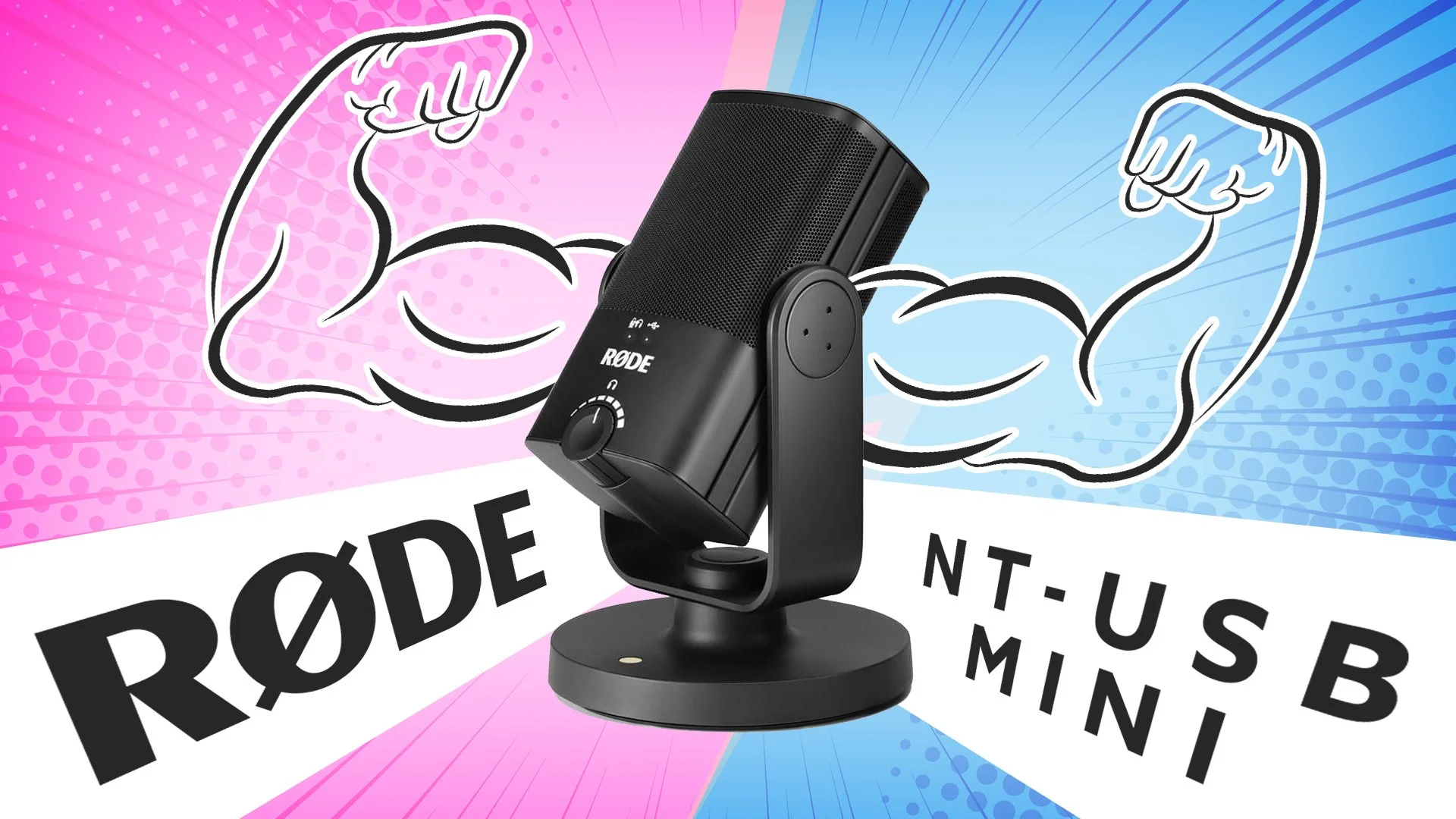
The Rode NT-USB Mini caught my attention some time back when I was looking for an affordable, USB only input for our podcasting clients. Especially if you’re starting out fresh as a podcaster and you don’t want to make a huge investment in a bunch of gear up front, the Rode NT USB Mini has proven itself to be an extremely useful microphone.
As with any microphone however, there are a few things that you need to be aware of to ensure that you have the best audio quality possible. I’m sharing some of the specific mistakes that you can make with this microphone to help you deliver audio gold.
Compact and Portable Without Sacrificing Quality
First things first, let's talk about its size. The Rode NT-USB Mini is an incredibly compact condenser microphone that you can easily take with you anywhere. Whether you're on the go or setting up a makeshift studio wherever you are, this microphone is a very useful option.
Not only is it compact, but it also comes with its own in-built pop filter for reducing plosives, though you need to place it off-axis and a little way from your mouth in order to not have the plosives be a problem. The in-built pop filter doesn’t quite do the job as is.
User-Friendly RØDE Connect Software for Seamless Recording
What sets the Rode NT-USB Mini apart from other microphones in its class is the dedicated RØDE software that you’re able to download to your Mac or PC. With this software, you can effortlessly control a few settings within the microphone and even record directly onto your computer using just the software. No need to download any additional recording tools (if you’re operating audio only). It's like having a mini recording studio right at your fingertips!
Optimal Positioning Is Key
Proper microphone placement is key to achieving a great result from this small, but mighty microphone. One common mistake I see people make with this microphone, and others like it, is placing it on their desk. Placing the microphone too far away from your face leads to poor sound quality. Instead, I highly recommend having the microphone nice and close to your face for the best results.
To achieve this, consider using a boom arm such as the Rode PSA1+ to hold the microphone. The Rode NT-USB Mini is designed to be compatible with boom arms, allowing you to position it comfortably close to your face without having to hold it the entire time. This way, you can focus on your content creation without sacrificing audio quality.
Dealing with Plosives and Pop Filters
Although the Rode NT-USB Mini has its own in-built pop filter as I mentioned, it's worth mentioning that it doesn’t do a fantastic job of minimising them. Plosives are those pesky popping sounds you hear when pronouncing certain words, particularly with heavy “p, b, t or f” sounds. To minimize them further, consider using an external pop filter.
The tricky part with pop filters is finding the right size that doesn't obstruct your face further if you plan on recording with video. However, there are smaller pop filters available that work just as effectively without taking up too much space.
Leveraging a boom arm enables you to attach the pop filter directly, improving audio quality while maintaining convenience. For those of you constantly on the move, propping up the microphone on books or a sturdy box can provide the necessary elevation for optimal sound capture.
Sound Quality and Affordability Combined
The Rode NT-USB Mini has exceptional sound quality for such a small footprint. This microphone delivers clear and professional audio that is sure to impress your listeners. Whether you're just starting out with podcasting or looking to upgrade your setup, this microphone is a great choice.
At a price point of around a hundred Australian dollars, the Rode NT-USB Mini is an excellent investment. It's affordable, yet it doesn't compromise on quality. It's the perfect starter microphone for anyone considering podcasting or content creation on a smaller budget.
BAMBY MEDIA LINKS:



Transcript:
-
[00:00:00] Brianna: Today, I'm going to run you through a little microphone that I have here in front of me called the rode NT USB. Mini. And I wanted to talk to you specifically about this microphone because it's getting close to the holidays and you may be wanting to do some recording, not at your house. Not at your normal home studio setup and perhaps the setup that you have there at home, you have quite a significant microphone.
[00:00:35] Maybe you have a boom arm. , maybe you have just all the bells and whistles for that location. I have a really nice option here with the road, anti USB mini. because I can take this little thing basically anywhere and I thought it might be something useful for you too. Be aware of that, this microphone I'm talking into it right now. When I have it nice and close to my mouth that you can hear here.
[00:01:02] It's actually quite a beautiful sound. Isn't it? Like, if you just really listen to how my voice sounds here. It's quite nice. Now, it's not. Perfect. You've just heard there when I said perfect. Can you hear that there is a plosive happening. So the road NT, USB mini does have. What they call an inbuilt pop filter To means that it helps reduce some of those plosives that I just mentioned there, but it doesn't do an awesome job and it is a, quite a small microphone.
[00:01:34] They can't really pack a whole bunch of extra pop filtering goodness into it, based on the sort of cage then house that it's in. So I'm not surprised that even though they say it has an in-built pop filter and you don't need one. I'm not surprised that you actually still really do, but in saying that you can kind of get around it.
[00:01:56] So in this situation, what you need to do right now, when I'm [00:02:00] talking into the microphone, I'm talking into it in what you would call on axis, meaning I'm straight in front. My mouth is straight in front of the microphone. And when I do my big heavy sounds.
[00:02:17] that's on axis. it's going to be picking up everything because it's right there in the front, straight on. Now, if I move the microphone slightly to the left or the right. So I've just moved it off to the right a little bit. It's now off access.
[00:02:31] So the breath isn't hitting straight into the microphone because the microphones now have access. So if I now go per. For. See how it's A lot less per.
[00:02:47] So that's the way that you can get around that plosive issue that this particular microphone does still have is if you can move it to the side and have it in an off axis time for format. Then you won't have anywhere near the issues that you have with it straight on. So that's why I say that you can still use this as a good travel microphone with no extra pop filter, no extra anything, because if you position it properly, if you do a little bit of good microphone, technique, Then you can absolutely just use this, take it anywhere. The other thing I'll mention about this is that it does come with its own. Uh, stand like a magnetic stand giving you the option of putting it on a desk. But I'm going to show you now, and I want you to listen to what happens is if I put this microphone down, I'm currently holding it.
[00:03:38] If I put this microphone down on my desk,
[00:03:46] Now it's down on my desk. Can you hear the difference? If it's down on my desk, where is it in relation to my mouth? Is it close? No. It is not. [00:04:00] It is very far away. Now I have to position myself. I have to hunch over. Crawl right in. And get to where I would want to be with this microphone. So to have it on the desk, actually, isn't that helpful? Unless you're putting it on some shoe boxes or something else to prop it up to the level where your mouth is actually positioned, it makes zero sense.
[00:04:27] And I advise you to never just put this microphone or any microphone. On the desk, even if it has a desk stand. Without you propping it up to get it to the position that is close to your mouth. The further away I get. Here. I am just sitting where I would at my desk.
[00:04:50] And seal it extra sounds that you can hear.
[00:04:52] Now there's a flight, a plane flying overhead as well. But the desk is also making, it's got its own little rumble. Because the computer's on and there's a little fan noise with the computer. I think my hard drives backing up at the same time. If you position it on your desk. It's picking up everything, picking up all those little sounds.
[00:05:14] And if I tap.
[00:05:17] My desk. I hit it by mistake. See how you can hear that because The fact that the microphone is on a stand that's on the desk. You will pick up all of those sounds. Now I'm going to take this microphone back up and I'm going to pick it up.
[00:05:37] So here it is in front of me now at the position that I would want to have it.
[00:05:41] I'm holding it currently. Can you hear that? The sounds that were potentially there before, like the noise from the computer, things like that have really minimized.
[00:05:55] Because I'm now close to the microphone. Very close.
[00:05:58] So [00:06:00] if you're going to be using this microphone, traveling around, which I do, I take it with me basically anywhere if I'm going somewhere and I'm not at my home, I will bring this microphone with me.
[00:06:11] Then no that you're either going to want to hold it.
[00:06:16] All you're going to want to position it. On some shoe boxes, even maybe on a bed and then you're sitting off the bed. So it's kind of close enough to you. Just really think about it for a minute. Think about where your microphone is best placed and just get used to doing some better microphone technique.
[00:06:36] Taking it off axis is going to be a really huge help for your plosives. and did, you know, as well that voices actually sound different based on the side of the mouth that a person. Talks out of most regularly. It's something that I learned when I was doing my audio production, a university degree. Where you would actually listen to a person talking and singing. And you would walk around them as they were singing or talking. And listened to where they sounded the best.
[00:07:10] So it seems quite silly maybe to think about now, but. Then you would position the microphone where they sounded the best, So if I move this microphone now okay.
[00:07:20] Around my mouth. This is me moving the microphone. This is me moving the microphone. This is me moving the microphone. Now I'm completely on the other side of my face. Can you hear a difference between one side and the other side? And I'm going to go back now. So starting from the left side of my face, and now I'm moving into the center. And now I'm moving over to the right. Can you hear that?
[00:07:43] I sound different based on where I actually talk out of.
[00:07:49] And so that's something that you could think about too. If you wanted to just try and get the best possible location. Is where do you actually sound the best? And the cool thing with the [00:08:00] Verdun to USB mini as well is that you can plug headphones into the back of the mic. And that means that you'll be able to monitor yourself so you can hear what you sound like as you recording. So that's my little tiny masterclass on using a tiny little microphone. For your travels. If you're planning on doing any sort of digital nomadism over the holidays, and you really want to still take some gear with you. Just pick yourself up something like this rode NT, USB mini, and I will link it. They are out affiliate, Amazon links.
[00:08:32] Just know that if you do purchase something through our link, we get a little percentage. Uh, kickback there, which is always nice. I am going to be reviewing some new products from a different microphone brand that I absolutely adore over the next couple of months. And so my opinion may change after I review and test these new microphones.
[00:08:52] But as of right now, Uh, for this price point, which is around 120 something dollars. This is a perfect little travel microphone for you to take with you. On location. And just remember to do a little bit of extra microphone technique. to make you sound as amazing as possible. Have a great day.