The best USB microphone for podcasters in 2024?
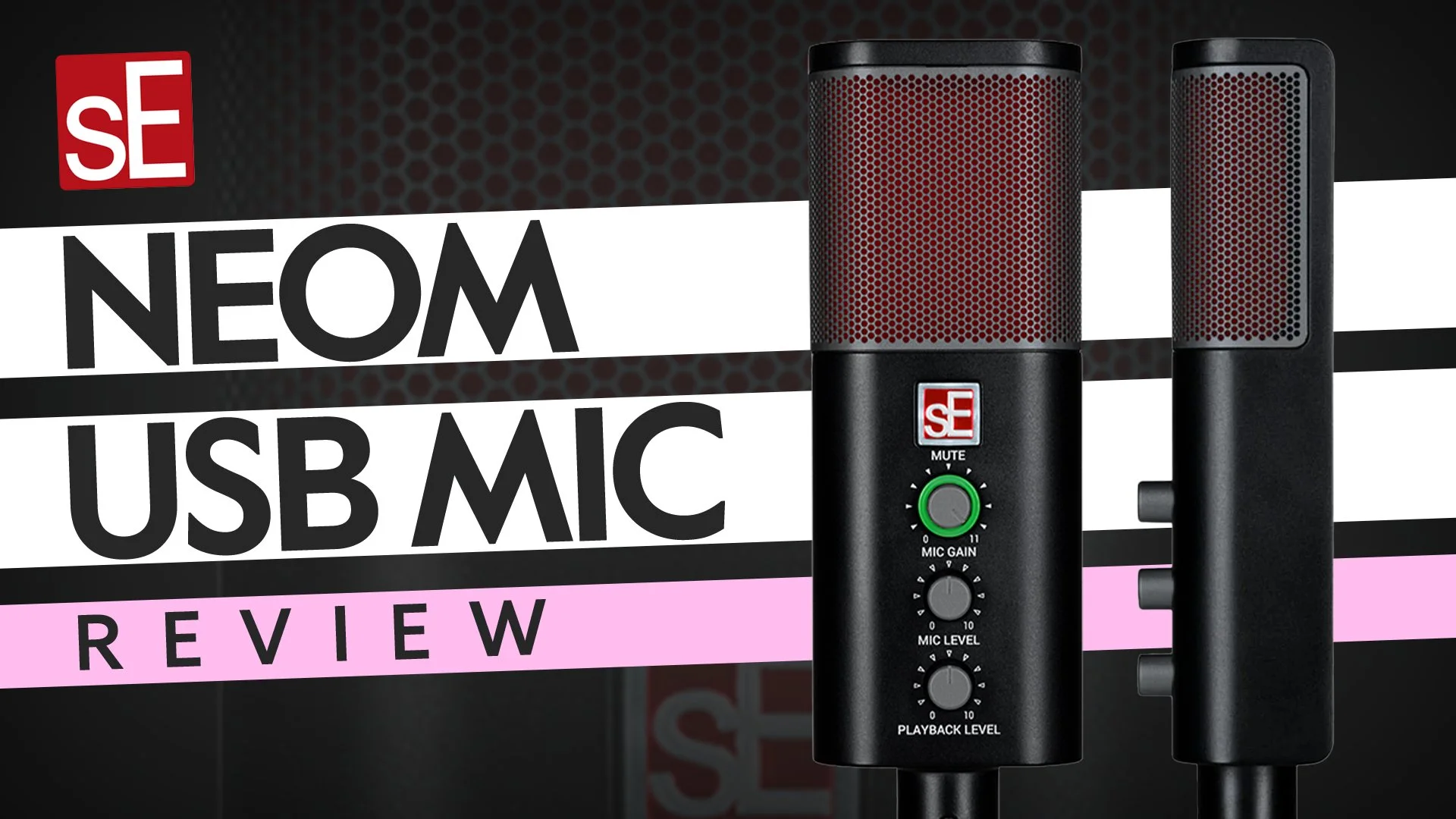
The sE Neom microphone presents an intriguing option for podcasters seeking USB-only solutions. With its distinct design, on-brand red meshing, gunmetal colouring and unique features, the sE Neom aims to carve out a niche in a crowded USB microphone market.
I have been testing this microphone now for about 6 months in a variety of locations and use cases. As a podcaster myself and a producer of over 50 podcasts, I’m always looking for microphones to recommend to my community.
So let’s put this one to the test shall we?
Design and Features:
The sE Neom immediately impresses with its sleek appearance, designed with both functionality and aesthetics in mind. It features a headphone jack on the rear for direct audio monitoring and a control panel of knobs on the front. Notably, the microphone offers three control knobs: a dedicated mute button, mic gain adjustment, and controls for headphone monitoring and playback levels. These features distinguish it from many other USB microphones, which typically lack such onboard controls.
Most commonly you’re left at the mercy of the sound settings on your computer to get your levels right, and need to make further adjustments via your DAW. It was a pleasant surprise to me that I was able to make these adjustments easily via the microphone itself.
Sound Quality
Sound quality remains the ultimate measure of a microphone’s success and this microphone did not disappoint. It’s probably one of the nicest sounding USB microphones that I’ve had the pleasure of reviewing.
The one issue I have is that it needs a decent pop filter, and it doesn’t ship with one. To have the microphone positioned where it sounded the best, the plosives were quite strong and although the microphone looks beautiful, I found myself needing to cover most of it up with a pop filter.
Its polar pattern optimally captures sound from the front, providing a stable audio output for podcasters, albeit less effectively in spaces with poor acoustics. I’m a big softie for condenser microphones, but in untreated spaces they can be harder to manage.
Technical Specifications
The sE Neom supports a frequency range of 20 Hz to 20 kHz and sample rates from 44.1 to 192 kHz. These specifications are suitable for various audio applications. However, I found that the microphone didn’t function when I plugged it into my Satechi USB hub. I needed to plug it straight into my computer/laptop for it to work. Definitely not a dealbreaker, just something to be aware of.
Usability for Vocalists
The sE Neom, as a condenser microphone, faces difficulties with dynamic volume levels, particularly for vocal performances in untreated spaces. Without a DAW and compression, it may peak during recordings, necessitating careful mic technique to manage levels effectively. This characteristic may limit its appeal to vocalists accustomed to simpler setups or trying to produce music at home in a less than ideal environment.
The sE Neom proves to be a strong candidate for podcasters, especially those recording in controlled environments. Its sound quality shines for audio-only purposes, notably with close proximity recording. However, as it is quite a large microphone and requires a pop filter, it could be limiting for video podcasting. I found that it takes up quite a lot of real estate on video, and for this reason I wouldn’t recommend it to video podcasters.
Would I recommend this microphone to audio-only podcasters and voice over artists? In a heartbeat! It sounds beautiful with a glorious depth to the sound and sparkles for female voices especially.
Another great product from sE that I loved putting to the test.
Thanks to Chris from Sound and Music for sending me this microphone! They’re a great bunch of humans based out of Melbourne who are one of Australasia’s leading importers and distributors of technology-based musical instruments and audio equipment.
Transcript:
-
[00:00:00] Today, I'm testing out a microphone called the SE Neom. It is a USB only microphone brought to you by SE that I thought I'd give a little bit of a run because they don't really have any other USB products. And I wanted to see whether they brought something to the podcasting space that felt like a good fit for podcasters.
[00:00:22] And so here it is. Is now we've got at the back of this microphone, we have the headphone jacks. You can plug your headphone straight into it. And then on the front of the microphone is where all the other action is. You've got a mute button, a dedicated mute button, which actually is really good. And then you've also got.
[00:00:40] Three other controls here, which most USB, in fact, I would probably argue all other USB microphones don't have, they don't have knobs for all these specific things. So below the mute button, you have a mic gain button, and this is controlling how loud you can turn up the microphone level, like how strong the signal is.
[00:01:03] Most USB microphones don't have that control, on the microphone itself. You can go into the settings of your computer. And of your sound settings and control the microphone level from there, but you can't do it on mic. And so this is really good. I really like that. It has that as a feature. Next one down is the actual mic high level.
[00:01:22] Level control. And that's for your headphones. So how much of the microphone and yourself do you want to hear in your headphones? And then the next one down is the playback level. So if you've got music coming in at the same time, like in your headphones, how much of that do you want to hear versus how much of yourself do you want to hear?
[00:01:40] There is knobs for each of those things, which again, is something that I, for any other USB microphone that I have tried, they don't have that kind of customization. This microphone. Is the only one that does that.
[00:01:58] Let's actually get [00:02:00] into how this microphone sounds because that's the most important thing the knobs are certainly nice You know, it's nice to have some of those I like the you know feedback on that But as far as how it actually sounds let's just have a little listen to it So that you can decide for yourself whether you like it as you're listening to it.
[00:02:18] Now, what do you hear? What do you hear in my voice? Do you hear nice things or do you hear not nice things? Is there anything that is missing for you? Now the first thing that I would say about this microphone straight off the bat, if this is for podcasters, is you need a pop filter. You cannot use this microphone without a pop filter.
[00:02:36] Did you hear me pop then? Pop. There is a very significant issue with this mic and so unfortunately that sucks a little bit because this microphone looks really cool and now I have to cover it with a Pop filter. I'm just using the pop filter that came with my other SE product, which is the SE DCM8, which is the microphone I use a lot.
[00:03:01] Okay. This is my favorite microphone at the moment. I've done a bunch of reviews and I've battled it against other microphones, like the Shure SM7B, which is, you know, the one that everyone uses. So we're just going to use this. Okay, we're going to put it on top doesn't look very good anymore. And now you can't see my mouth So i'm just going to bring that down a little bit So now when I do my pops pop pop pops, it doesn't have anywhere near the popping sound, which is good So you definitely need a pop filter For this microphone, for it to work, the microphone has a polar pattern.
[00:03:37] That only has the sound being picked up from the front and around. If I'm over here, you can hear it, but not as much. If I'm over here, you can hear it, but not as much. If I'm over here, you can hear it really well. If I turned it around, then this is not picking up that it's picking up from here at the back.
[00:03:56] So definitely don't face it this way because that's not the way it should be facing.[00:04:00]
[00:04:02] Okay, and so then now it sounds much nicer, doesn't it? Because it's in the right location. So this microphone is a condenser microphone, which means it's going to be suited best for spaces that are more controlled, environments that are more controlled. This environment that I'm in right now is not a controlled acoustic space.
[00:04:21] And I do that on purpose just because. For mostly what I'm reviewing here on this channel is stuff that podcasters use and they're mostly at home podcasters, so they don't have treated spaces, they don't have acoustic paneling, they don't have that sort of stuff. And so it's best for me to try and emulate that when I'm doing this sort of thing, so that I'm not giving you a false sense of what your microphone is going to sound like.
[00:04:45] This is a very small room, this is like two, three meters by two meters. Two and a half or something, maybe three by three. I haven't mapped it out, but it's quite a small space. I've got lots of hard furnishing things in the background there. Lots of Lego bookshelves. I've got a hard desk. I've got concrete floor.
[00:05:02] You know, it's not a space that I would recommend for podcasting and certainly not for podcasting. Music making for vocals, but it is what most podcasters have. They have something like this. I've got a little rug on the floor, but that's pretty much it. So there's lots of things for this to bounce off.
[00:05:20] Just making you aware of that right off the bat. For those interested, it has a frequency range of around 20 Hertz all the way up to 20 kilohertz, and it supports sample rates starting at 44. 1 all the way up to 192 kilohertz, which is really good. So that's the normal things you kind of look for in a microphone.
[00:05:37] Yes, it's USB. Does it have some controls? How does it look? How does it feel? Do you need a pop filter? That's all the stuff you kind of need to tick, tick, tick, tick, tick, tick off to begin with. The next thing I'll say as well with this particular USB mic is that you need to plug it into the back of your computer.
[00:05:54] Or like your laptop, not with a USB hub. It doesn't seem to work, uh, with it [00:06:00] being plugged into a hub. And I've got a Satoshi hub, which I've had for ages, and it works with all my other USB microphones pretty much, but it doesn't work with this one for it to work for me, I had to plug it into the actual computer itself.
[00:06:16] Now, if we get onto a few little trials here, I mean, obviously you can hear the way it sounds when I'm talking. Uh, if I get closer to the microphone, this is the kind of proximity effect. I'm talking quietly. This is kind of the ASMR vibes as I get further away, sort of at a position where I potentially would be talking in a podcasting setting, then that's kind of what it sounds like here.
[00:06:37] So it's about, Oh, no, 10 centimeters maybe away. And then if I go back, Hello, this is me. There is no way I would ever do this or recommend that everyone anyone ever does this because it's way too far away It sounds like trash. I would recommend you never ever do that Now if we were going to sing into this microphone again, this is going to be a little bit of a struggle because the This is a condenser microphone and it does seem to have a little bit of a trouble with the Volume, it's not great with that, but i'm just gonna sing some so you can hear it So if i'm nice and close, all right At last, my love has come along, my lonely days are over.
[00:07:34] Sounds quite nice, doesn't it? Now, if I wanted to give it more juice, more volume, I'd have to be further away from the microphone, which means you're going to hear more reflections, and in a space like this I don't think that's going to work, ready? Life is like a song, oh yeah, yeah, yeah, yeah, yeah, at last.[00:08:00]
[00:08:00] The skies above are blue. My heart was wrapped in clover. The night I looked at you. Okay. So you can hear there that it peaks. Hopefully you can hear that it peaks quite a lot. Even if I'm all the way back there, it's not handling very well. So you would need to have this through a DAW. and having compression on at the time of recording for that to not peak all over the place.
[00:08:39] And so that's not ideal. If I turn the mic level down, now it's pretty soft. So now I have to get like really close. And then I go back to try and get it to not peak. Life is like a song, yeah, at least. The sky's above a oomph of blue, my heart was wrapped in clover. Okay, so I have to do a lot of like mic technique with this microphone to make that work.
[00:09:16] I'm just going to turn it back up. That's not ideal. This is not a microphone that I would recommend you use. for vocals, because it just doesn't, doesn't function very well with the dynamic level. And if all you're doing is using it, well, if you're singing, then there's so many other microphones that I would recommend for vocals other than this one.
[00:09:36] Now, if you're just recording a podcast and you're a solo person in your house, then this microphone's pretty good. You can talk really quite softly. It will pick it up very nicely. It's not bad. The only thing I would say. Is that, with this microphone, because it has to have a big ol pop filter on it, if you're hoping to have it be the [00:10:00] microphone that you use for YouTube, I don't think you should do that.
[00:10:02] Sorry, it's so big, it takes up so much room, and although it sounds nice, it doesn't look very nice. It looks better, like this. That looks better. That looks actually kind of cool. But you can't use it like this, because it's going to pop all over the place. Even if I go off axis. Hello, I'm off axis, popping, popping, popping.
[00:10:23] It's still popping, popping, it doesn't really matter where I am, okay? So, it does pain me. To say that for video, you wouldn't use this microphone for audio only. This is a fantastic microphone. This is a lovely piece of kit for an audio only professional. I'm going to put this back on. It wants to be able to do nothing to the sound after you've recorded it.
[00:10:50] No EQ, no nothing. This can handle that like it sounds really nice, especially for a female vocal. This is really quite special But I want you to be really close to the microphone to get the best out of it because it is a condenser microphone It needs to be close if your room is not something that you can control too much talk softly into it, close to it as an audio person.
[00:11:15] Video person, you got to get a different microphone. This is not going to be great for that setting. Vocalists, also not a great microphone for vocalists, in my opinion. That's my wrap up of this microphone, the SE Neom. If you want more, if you love this kind of thing, then please hit the like button, the subscribe button, leave me a comment.
[00:11:36] What do you think? Do you like the sound of this microphone? If you watch some of my other videos, what do you think? How does this one compare to some other microphones that I've got in there? I'm going to do a battle with this microphone between some of our other USB microphones, and we will see who wins there as well.
[00:11:53] Stay tuned. Bye.
BAMBY MEDIA LINKS:
GEAR WE USE HERE AT BAMBY MEDIA:
Aputure Amaran 200d LED Video Light