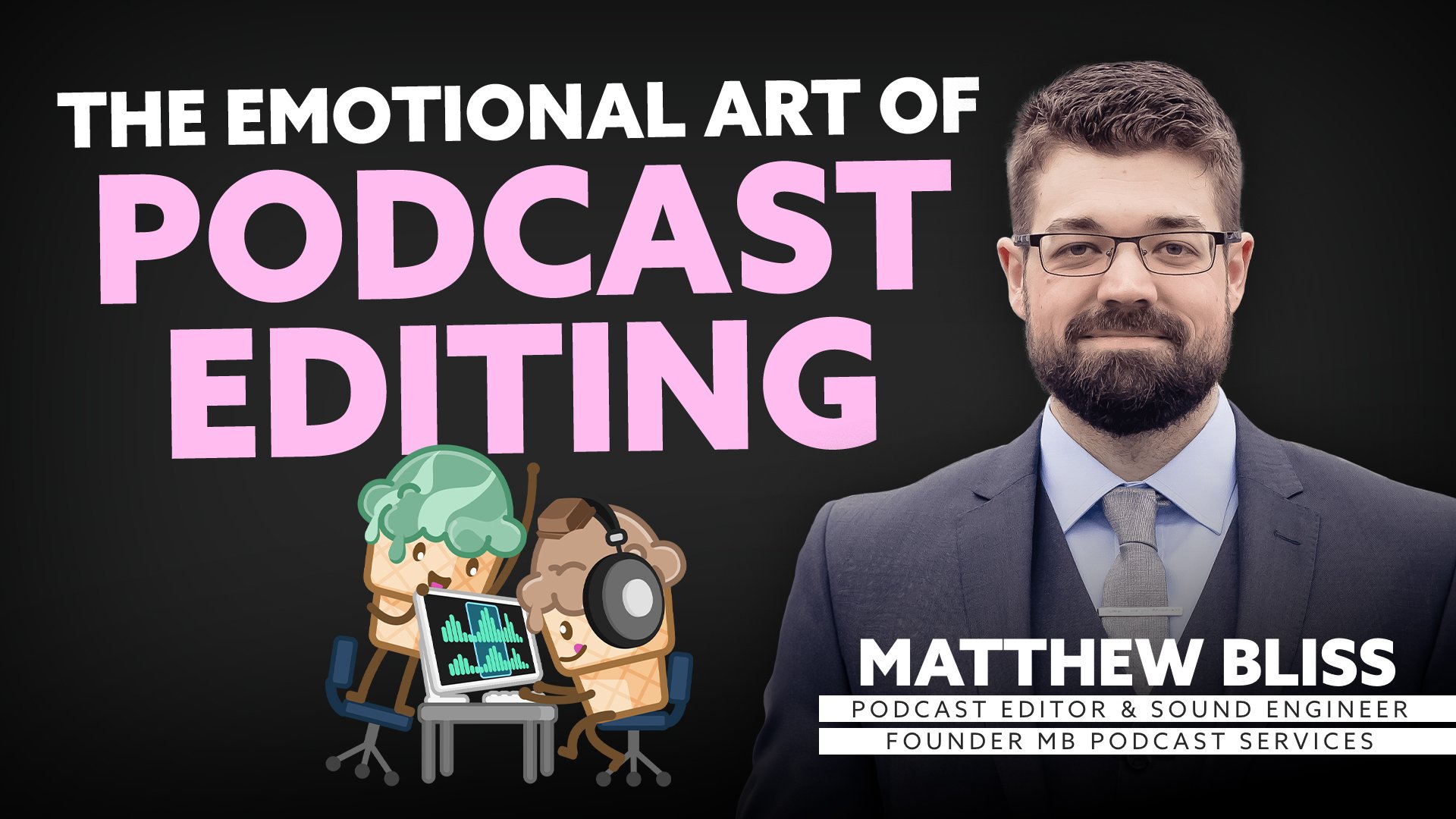
The emotional art of podcast editing with Matthew Bliss
When you’re listening to a podcast episode, do you notice the technical aspects of the edit?
If you said yes, I’m going to bet you’re either a very avid podcast listener, or you’re an editor yourself.
The truth of it is that most listeners don’t notice the editing on a podcast (unless it’s particularly bad).
The listener doesn’t hear the original raw audio. They haven’t seen the hours it has taken to craft a conversation into a compelling story, or the subtle use of silence to heighten emotions at key points.
What they hear is a polished episode that (hopefully) is a pleasure to listen to.
And the podcast editor has therefore done their job.
As someone who has edited hundreds of podcasts myself over the last 9 years, I can relate deeply to the challenges and rewards of crafting an emotionally resonant episode.
But as podcast editors, we don’t often get together to discuss not only the technical aspects of editing, but the emotional toll it takes on us. So I invited Matthew Bliss, podcast editor and business owner at MB Podcast Services to talk about this lesser-known side of podcasting.
One thing that struck me during our conversation was how deeply invested we editors become in the stories we work on. At Bamby Media, where we have five editors and around 60 clients globally, we get to know our hosts intimately through their voices.
This emotional connection is a double-edged sword—it enhances our work but also makes it challenging, especially when the topic we are editing has heightened emotions that we need to help pull out.
Matthew shared a poignant example from his experience working on the podcast "Kintsugi Heroes." This podcast features stories of people who have overcome significant trauma, drawing an analogy to the Japanese art of repairing pottery with gold leaf.
One story that stood out was about a man who survived blood cancer only to lose his father in a tragic accident. While editing such stories, Matthew found himself making tough decisions to ensure that the raw emotion was preserved without making the episode hard to listen to.
Creating an emotional experience goes beyond just editing out the ums and ahs. It's about knowing when to let a silence linger or when to add a subtle music track to enhance the mood. For instance, when editing the "Kintsugi Heroes" series about the massive floods in New South Wales, Matthew used a piano interlude to crescendo the host's impactful monologue. These choices aren't just technical; they require an emotional sensitivity to the story being told.
I’ve found that the best use of music in podcasting is to subtly manipulate the listener’s emotions. When I hear a story developing and the speaker becomes emotional, I often introduce low-level string pads or other background music to heighten the emotion. The goal is to make the listener feel those tingles, to pull at their heartstrings in a way that feels natural and compelling.
Editing stories that are as emotionally charged as those featured on "Kintsugi Heroes" or my early projects like "Slave Stealer" has a lasting impact. These stories stay with you, reshaping your worldview. I remember editing episodes about child sex trafficking and rescue missions and feeling the weight of those stories deeply. Knowing that my small bubble of existence was just a tiny speck in a world full of both suffering and resilience broadened my perspective.
Podcast editing is as much an emotional labour as it is a technical one. It's about crafting stories in a way that honours the experiences of those sharing them while creating a compelling listening experience. Matthew Bliss’s journey and insights affirmed what I've always believed: the emotional investment we put into our work makes it all the more rewarding.
If you're a podcast editor or thinking about becoming one, remember that your role is crucial. You’re not just editing audio; you’re crafting experiences that can change perspectives and lives. And as Matthew and I both agree, the power of podcasting lies in its ability to deeply engage and connect listeners with stories that matter.
Transcript:
-
[00:00:00] Brianna: Today we have Matthew Bliss on the podcast matthew came into my orbit, I think on LinkedIn originally. As a podcast editor. So, someone on the other side that has the headphones on all the time, that listens to everything that all you podcasters do, and makes it better. I thought maybe today it was going to be a really interesting conversation to have with Matthew about the actual editing side of things.
[00:00:28] Because if you're not editing your own show and you're handing it off to a company, to an agency, to an editor, you don't quite get what's involved with taking what is sometimes a turd and turning it into something that is incredible, So that's basically our job a lot of the time is you give us something that you feel needs work and then we turn it into something that really tells a story.
[00:00:55] Matthew, I'd like to know, first off, what was the pull to get into podcasting in the first place?
[00:01:03] Matthew: Well, for me, it largely started during the pandemic, getting started myself with a, with a humble blue Yeti, but understanding at the time as an Edison now that it's, very humble indeed.
[00:01:14] from 2020 until maybe, the end of 2021. That was my first journey into podcasting. I was, trying to figure out how to make me sound better and record engaging content.
[00:01:30] And for me having a very strong technical background in computer support and, training people with in IT, it meant that I started to hyper focus on every aspect. And the more you listen to yourself, the more you hear, how terrible you sound, which is, Partly a cognitive bias at the same time.
[00:01:51] It's a, technical issue if you have a blue Yeti that is. After that, I started hearing more and more and starting to fix more and more and [00:02:00] you start hearing the reverb and how to fix that and treat your environment to reduce echo. then you jump the massive hurdle of parametric EQ and, it's a fun game. It's a tough game to get into, but, once you get over those hills of, Figuring out all the aspects of audio that you need to make a podcast sound either passable or fantastic. Then you kind of catch the bug to do it for other people. towards the beginning of 2023, I started doing it for others.
[00:02:30] And, yeah, it's sort of emerged into a little business that I've got going for myself.
[00:02:34] Brianna: EQ, if anyone doesn't know what parametric EQ is, it is something where we take out, we listen to you intently from a, like, on the head, with the headphones or with studio monitors or something.
[00:02:46] We listened to your voice intently and we listened for all the annoying frequencies that most people won't realize are grating on them, but they are something that you can optimize and make someone sound a lot better. Especially if you're working with a microphone that isn't great and you're trying to give it more boost, you're trying to make it feel more like full of depth and full of some bass and then maybe the top end of that microphone has lots of sibilance and it has lots of little sort of sounds in that top that are really quite frustrating. That's one of the aspects of podcast editing that people don't really think about, but when we listen, we can hear all of that and you won't hear it because we've fixed it by the time it gets put out there. But there is an actual, definite, delicate balance that goes into making something sound better from EQ and you can also get it very wrong as well.
[00:03:46] So that's why Matthew was saying getting over that hurdle is actually quite a big one because until your ears are trained, you can't. You kind of don't even realize what it is that you are looking for. and it's something that you start to [00:04:00] learn over time what makes it good versus not so great.
[00:04:04] Matthew: And everyone's journey is different. Like I started with the Blue Yeti. That's not a parametric EQ problem. That's a reverb problem. Because it is a condenser mic that picks up the entire room. my next microphone after that was a Shure MV7X. Which is, by all accounts, a fantastic microphone. An XLR only microphone, not a USB. For my voice, if you're looking at a waveform, it just, sounded like all of the bars would be completely full on that waveform, like someone has done a really bad job editing it. Which is not the case, and unfortunately, if you're fighting a microphone with that issue, the real solution really is just to find a better microphone.
[00:04:51] Brianna: I want to know from you, how invested we get as audio editors into the stuff that we're actually editing.
[00:05:00] So to give context, here at Bambi Media, we have five editors, and 60 odd clients or something, a lot of clients, that we edit every week, we get very used to and emotionally invested in each of these hosts. We feel like we know them very well. We can tell when they're not feeling well. You can hear it in someone's voice when they're feeling a bit off or when they really shouldn't be recording because they're not really, like, that excited and they're not really that interested.
[00:05:38] They feel like they're pushing it out or something. We feel that we can hear it. And in the same way, Matthew has a podcast that he works on that. I'd like you to tell me the story of this podcast and the impact that that has had on you as an
[00:05:56] Matthew: now this particular client I picked up while I was still in Australia, [00:06:00] but currently living in Ireland. The podcast began as Kintsugi Heroes. now this was started by Ian Westmoreland as someone who's worked on mentoring men as a, uh, an organization to support men for over 11 years with the different kinds of issues that they experience.
[00:06:21] Much more common these days, I think, and visible. The art of Kintsugi, which inspired the name, is that the repairing of Japanese pottery with gold leaf to improve the value of that pottery after it's been broken. So that analogy carries over to the kinds of guests that are interviewed on Kintsugi Heroes.
[00:06:45] They are people who have experienced a great amount of trauma or adversity, and they have a story to tell and share. About how they overcame that adversity and have come out either for the better or Learn something about themselves or the world that they can share on the podcast with us, it's a very compelling podcast in the sense that There are some stories out there that you really wouldn't expect to hear that people can go through. in preparation for this, I, I thought of a few examples because at this stage, the podcast is about 64 episodes in, and there's a few other podcasts they're starting to begin under the same umbrella, all dealing with different kinds of stories. Like, in 2019 and 2020, there was a massive bushfire in Victoria, New South Wales, and That entire series is done.
[00:07:43] You can look it up right now. It's called the Kintsugi Heroes Alpine series. And that one interviewed people who were in the depths of the fires. They were either fighting them or had to evacuate their house and have been in recovery since then. And [00:08:00] shared those experiences. the current season that we're editing and releasing at the moment is called Beyond the Deluge. In 2022 in the town of Broke and the Hunter Valley in New South Wales, there was a massive flood, the kind that they haven't seen in 70 years. And even today, two years on, they're still recovering.
[00:08:21] People don't have their houses. They're still dealing with the fallout of that. but there's a couple of stories from the. The main podcast feed that really stand out in terms of the editing perspective as well as the listening perspective. Martin Gillespie, which I think was episode 14, he had come to Australia from Scotland. He had, Discovered he had a type of blood cancer, a very rare one, that he overcame, went home to visit his family, came back, and then found that his dad had had a heart attack while trimming the garden and landed on his garden shears. and it stabbed him right through the heart as well.
[00:09:09] So that was almost immediate death.
[00:09:12] Brianna: Hang on. He had a heart attack and then stabbed himself in the heart.
[00:09:17] Matthew: Potentially, I may be misremembering this one just a little bit. whatever the cause was, he fell off and landed on the shears that were sitting in his pocket and that was him gone. But the story doesn't end there. he had to immediately go back And, attend the funeral and be with his family.
[00:09:37] And upon attending the funeral, they discovered that there was someone in attendance who looked very much like him, almost exactly like him. they discovered that his father had been having an affair and a family with someone a couple of blocks away. And so he was introducing himself and coming to terms with having a brother that he [00:10:00] never knew about, like a half brother.
[00:10:03] And then he went back to Australia and unfortunately the cancer returned, as someone who's experienced all that, he's very much focused on sharing information about good health and taking care of oneself. Hearing and editing those kinds of stories can be very traumatic. And it covers the whole gamut of things. There's someone who had their first child that was told it was in such poor health that it would die within the first week. They took it home. It took a month for the child to die. It had no positive prospect of living. But during this time, she also discovered that her husband had been cheating on her and asked him to stop, which unfortunately he didn't. So not only did she have to deal with separation from a child that she was expecting to have, but also a husband that she thought she could trust.
[00:11:03] And it took years to come out of that hole, but she's come out for the better. So The Kintsugi Heroes feed is Available for you to look at if you're curious to hear more of these stories or if it resonates with you dear listener as someone who's experienced that kind of trauma it's part of the reason the podcast exists is that these stories can be shared and Part of the road to recovery is understanding that it's not just you.
[00:11:32] You're not alone but also that these stories can kind of inform your own recovery. Sharing is a big part of recovering from these kinds of traumas, so the podcast is a way to do that.
[00:11:45] Brianna: how lost do you get in the edit, in the story? How do you feel like it has changed you or has it changed you working on a show like this [00:12:00] that has a lot of storytelling and emotion involved?
[00:12:03] Matthew: well look, this is probably one of those things where I think to myself, I was probably built for this. Because I have a very easy time kind of rolling off the issues that get talked about on these episodes. in terms of the investment, hearing the raw detail of these stories. does mean that you are making interesting choices sometimes. I remember the first episode that I edited, there was someone talking who had, I think his wife had a brain hemorrhage while they were on a bike ride, or someone had assaulted her, I can't quite recall, but During the podcast, because he had his own company where he was mentoring and coaching and talking to people, he had a way of delivering his content that had so much impact. The problem with that as a podcast editor is at least at the very surface level, you think, okay, no spaces, we don't want to hear waffle, we want to remove filler words, all these things that AI purports to do, but we'll maybe talk about that in a sec, now listening to it and the way that he delivers the content, you start to have to think to yourself, well, how do I edit this thing together?
[00:13:28] Because every word has such gravity. and impact to it, and such raw emotion. Like, as a raw conversation, you probably want to leave it alone. You know that as a podcast listener, you're not going to sit there waiting with two seconds of silence between every sentence to continue listening.
[00:13:51] There's just a different audio listening experience to, to listen to. watching someone. part of the emotional investment of doing the editing is hearing the story and [00:14:00] wanting to make sure that that story that you end up cutting together doesn't remove what represents what they're trying to do.
[00:14:09] Brianna: that you're representing them as they are, but also
[00:14:13] making it an experience for the listener where they can feel connected even if they can't see the person. Is that
[00:14:21] essentially what you're saying?
[00:14:22] Matthew: what that means necessarily as an editor is you have to be open emotionally to feeling the experience and understanding what the listener's experience will be like listening to that emotional moment. And that's probably the biggest part of doing this kind of editing for these types of stories.
[00:14:37] Brianna: Yeah, it's very powerful, and I think, one of the best ways to pull that emotion, is when I hear things like this where it's a story that's developing and there's someone that's getting really emotional about a topic, is I let, I let the silence go But then I find music or folly and I put it in to heighten the emotion.
[00:15:03] Because what I want is the listener to do is really feel like tingles. I want to pull out as much of the actual emotion that I can. And sometimes, The best way to do that is actually introducing low level string pads or some sort of building music that, that really creates this sense of urgency or, you know, or just it. sadness, whatever the emotion is, that's something that can absolutely help in those situations.
[00:15:36] If you don't have video cues, if you're only working with audio, certainly what I've found to be the most effective in doing that. so I've been doing this now for about a decade as an audio editor. And then before that, a podcast editor, before that I was 15 years as a musician.
[00:15:54] And so obviously I'm very rooted in, creating stories and telling stories and pulling [00:16:00] emotions out of music. Then when I moved into audio, speech, I had that struggle that you explain where it's like, how do I get that emotion to land? Like, it needs to land, it needs space, but It also can't be boring.
[00:16:18] Like it can't be too full of gaps. It has to be something that pulls someone along that keeps them listening. I worked on a show called Slave Stealer originally by, brought to you by Operation Underground Railroad. It was actually one of my first ever jobs. And I would sit there bawling, like actually bawling my eyes out, editing this show, because they talked about child sex trafficking, they talked about really just awful things, and going on missions, and, rescuing children, and I had a small child at the time.
[00:16:54] and I couldn't separate
[00:16:57] from
[00:16:57] the emotion of that because it felt so real, it felt so real. Like, it didn't make sense to me that this was a world, firstly, that I never knew existed before that moment, before I started editing this particular show, And I couldn't unlearn it as well.
[00:17:12] And that's something that, as a podcast editor, you now know all these things that you never knew before and it brings you to a different place.
[00:17:20] That's why I asked the question of, like, how has it changed you? For me, personally, it changed me in a you know, Instrumental way where I went hang on my life is a tiny bubble I'm a tiny speck on a giant world where there's a bunch of stuff good and bad that happens and how can I create a experience for someone where firstly they learn something, they feel a real emotion, and hopefully they do something as a result of what they're just listening to or watching, if that's, if it's a video experience.
[00:17:55] So I definitely understand, and I definitely see [00:18:00] the power in creating space, silence, and then also using music and folly to heighten a mood in ways that your audience doesn't even actually notice. Realize is happening
[00:18:14] Mm-Hmm.
[00:18:14] Matthew: Yeah, that's the best use of music. I'm just discovering this for myself. and I guess that if you watch the trailer for the Flood series for Kintsugi Heroes, you'll hear some of that work for me. Like, I picked a, we've got the host delivering kind of a monologue about an introduction to the series and their experience.
[00:18:38] And it's like a piano interlude from a royalty free music site, and it just kind of crescendos the more he talks about it, but you can't just mathematically put that into, a waveform. You have to feel it. You're probably very familiar with the moment where you put a track in and you kind of shuffle it around and move it to different places and then you hear them say the thing and it like hits the big moment in the track and you're like, oh man, that's the one.
[00:19:08] Brianna: when it does drop off too. It's like it heightens.
[00:19:10] heightens, heightens, heightens, and then it's just, you know, and it makes you feel, makes you feel things, which I think is the whole point of your job. Of my job. Although I don't edit very much anymore. I kind of wish I did.
[00:19:22] it gets me so excited about, I just love all this stuff. Your job is so important and it's something that if you edit your own show as well, the listener, you know that you actually understand how important your job is to create a sense of purpose around each individual episode that you're creating.
[00:19:45] Why does it exist? Who is it for? What emotion are you trying to evoke? Is there a story that you can feed? into it? And then how do you tie it all together into something that feels really firstly produced, not [00:20:00] overproduced, but feels succinct and like someone can actually learn from as well. So yeah, I just think that it's an important role
[00:20:10] Matthew: podcasting is getting flooded There's so many people that are coming to the medium keen to get stuck in and share their own stories. But a lot of what gets talked about is the technical stuff. And that's when the AI stuff comes in and platforms like Riverside, they can offer functions like removing ums and ahs and fillers and silences.
[00:20:30] But as we just said, those silences, there's value in them. I don't think I've seen a course offered for podcasters on how to emotionally resonate and express a podcasting story. And if there are some, then I'd love to hear about them because they would be the ones to recommend to people to, to get a decent podcast going.
[00:20:54] And again, you know, every podcast is different. If it's video game news, if it's movie reviews, it's going to be lighthearted, but if you're someone with a story or, telling people's stories, then having the skills to do the things we've talked about today is going to be really important to you.
[00:21:11] Brianna: Oh, Matthew, it's been so great having a chat to you about. Something that I personally I'm obsessed with it. obviously being someone who's now been working in the space for so long and not sick of it. So it's just been a joy to actually talk to you about it. And everyone, we're going to put links in the show notes today for the podcast that Matthew has talked specifically about so that you can go and listen to A, some of the work that he's done, which is super cool.
[00:21:40] And then also just these stories sound really impactful. They sound like. if you feel like you're having a bad day, and you're all, woe is me, then sometimes something like this is what you need to go and listen to. It's putting yourself in a situation where you realize that there are people that have it so much [00:22:00] worse than you.
[00:22:01] I think that that's powerful as well.
[00:22:03] Matthew: It's, it's not even that. I think it's, it's more of the idea that when people say go to a support group and that can be the biggest step, this is a way for you to hear about experiences, kind of share your own in your own mind as you hear about them, and connect with someone. Because as we know, is an incredibly engaging medium.
[00:22:24] It engages in a much different way to snappy YouTube videos and radio shows. That kind of engagement and connection,
[00:22:32] Brianna: Yeah, that's beautiful. Absolutely. Oh, all right. Well, thanks so much. And I will talk to you again soon.
[00:22:40] Matthew: Absolutely.
MATTHEW BLISS LINKS:
MB Podcast Services
Matthew’s Podcasts:
Coffee with a Podcaster: https://coffeepodcaster.captivate.fm/listen
From My Home to Yours: https://frommyhometoyours.captivate.fm/listen
Kintsugi Heroes:
Kintsugi Heroes - Alpine Series
Beyond the Deluge (Flood Stories)
Episodes Referenced:
BAMBY MEDIA LINKS:
GEAR WE USE HERE AT BAMBY MEDIA:
Aputure Amaran 200d LED Video Light