Fifine Amplitank Tank 3 Review: The Best Budget Mic for Beginners?
Shopping for your first microphone means wading through hundreds of options with wildly varying quality and confusing specifications. Most beginner-focused advice pushes expensive gear that's overkill for someone just starting out.
I’m always on the lookout for budget-friendly microphones that will help you get started, but I’m also wary of things that are too cheap. As far as audio equipment is concerned, my general rule is that if it’s cheap, it’s probably poor quality. The Fifine Amplitank 3, though, did prove me wrong on this occasion, which was a happy surprise to me.
After testing the Tank 3 (provided by Fifine for review) across multiple recording scenarios at Bamby Media, I can tell you exactly what this budget microphone does well, where it falls short, and whether it's worth your money.
Build Quality
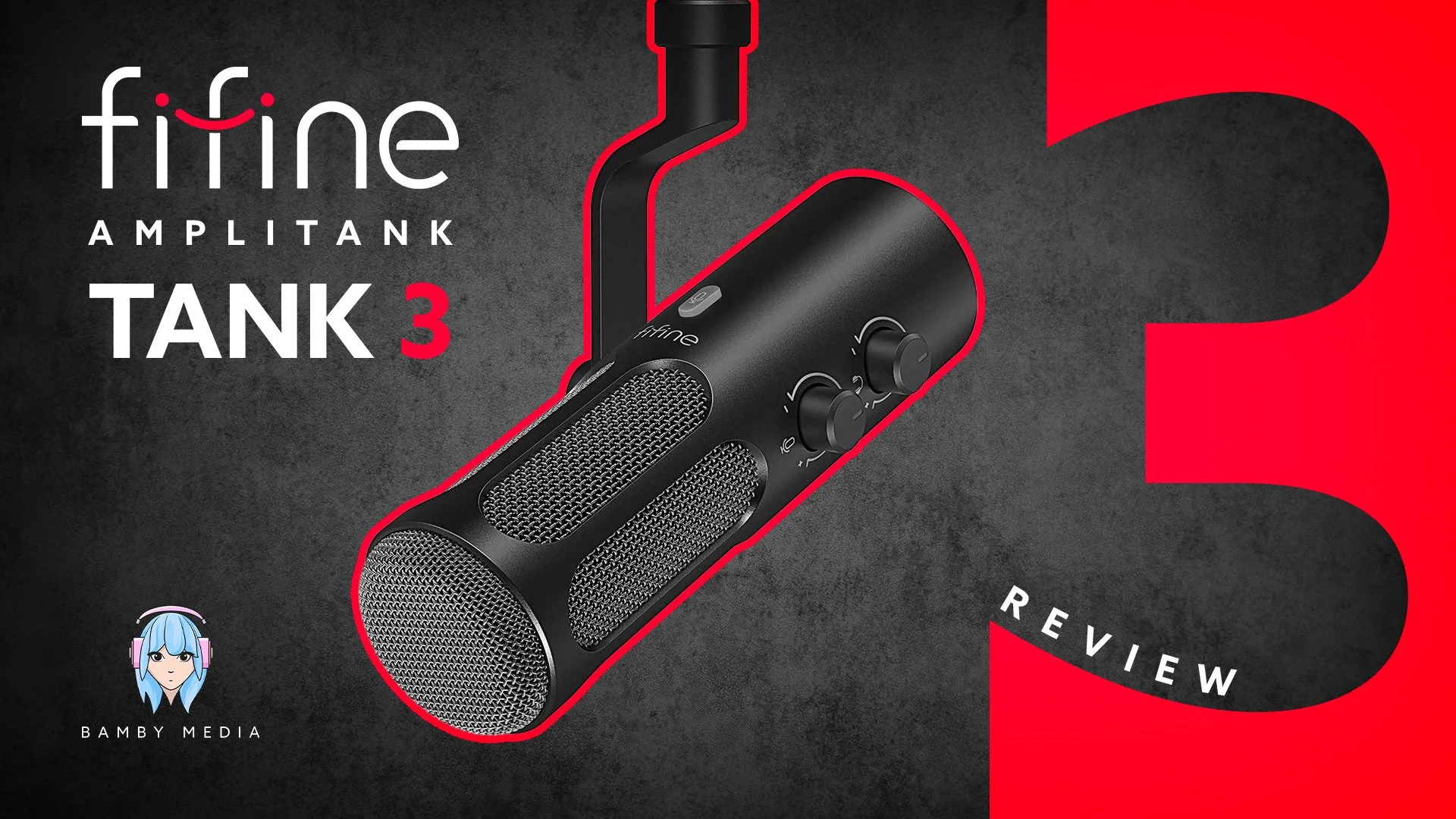
The metal body construction is impressive for an entry-level microphone. Controls are straightforward: mute button, gain knob, playback level control and headphone jack for real-time monitoring. Everything is clearly labelled and accessible, which matters when you're a newbie and all of the knobs make no sense.
Setup Process
The Tank 3 uses true plug-and-play USB connectivity. Connect the cable to your computer, select it as your input device, and start recording. No driver installation, no software configuration, no troubleshooting required.
For beginners who want to focus on content creation rather than technical setup, this simplicity is crucial.
Sound Quality Performance
The Tank 3 delivers clear, natural audio with some background noise rejection.
The microphone didn’t handle plosives well at all. I would definitely recommend you purchase a pop filter (they’re relatively inexpensive) because as you’ll hear in this video, the plosives are quite prevalent.
Sibilance is worth mentioning too because this microphone does highlight the “s” sounds more than I would have liked. I do find this often with more budget friendly microphones, but the sibilance wasn’t so bad that I wouldn’t recommend the microphone. It’s just worth mentioning because you’ll need to do a little bit of work with the EQ in post-production to fix this issue. This video showcases the sibilance for you here.
When singing into this microphone, I was pleasantly surprised with how it sounded overall. There was enough depth to capture some of the nice tones in my voice. It sounded better singing in my higher register than my lower register, and overall the microphone doesn’t perform as well in the bottom end.
Speaking of bottom end, there is also a difference in overall sound and tone with the USB input vs the XLR input. USB features more bottom end frequencies and an introduction to “muddy” tones. The XLR input did not suffer from the same problem. In XLR mode though, you need to be sure that the Tank 3 is going into a good quality pre-amp. I had to set the gain to the absolute max on my Focusrite Scarlette 8 Pre in order to have the XLR at an appropriate level for recording.
I know I’ve just mentioned a lot of potential issues, but I do have to say that none of them were huge in the scheme of things. I had to keep reminding myself of how inexpensive this microphone was and with that price point in mind, I was quite impressed with the Tank 3 overall.
Does it match the detail and warmth of microphones costing three times as much? No. But for its price point, the audio quality is genuinely impressive rather than just "good enough."
Who Should Buy This
The Tank 3 makes the most sense for:
Beginner podcasters needing reliable audio for solo shows or interviews without complex setup requirements
Musicians recording demos and practice sessions who aren't ready to invest in professional studio gear
Content creators producing voiceovers, livestreams, or video content who need consistent audio quality
Online educators and remote workers wanting better audio than laptop microphones provide
The Fifine Amplitank Tank 3 delivers legitimate value for beginner content creators. The audio quality exceeds expectations for this price point, build quality feels professional, and setup simplicity removes technical barriers that often frustrate new podcasters.
This microphone won't replace professional studio equipment, but that's not its purpose. For creators starting their audio journey, the Tank 3 provides everything needed to produce quality content without the intimidation factor or expense of advanced gear.
If you're a beginner looking for your first proper microphone, the Tank 3 deserves serious consideration. It proves that entry-level pricing doesn't require a huge reduction in usability or sound quality.
Full disclosure: Fifine provided the Amplitank Tank 3 for review. This article reflects my honest assessment after real-world testing. If you purchase through affiliate links, I may earn a small commission at no additional cost to you.
Transcript:
-
[00:00:00] Brianna: Welcome back to my face. My name is Brianna. I'm the head honcho here at Bambi Media. Today I am giving the Amplitank Tank three a review, thanks to Fi fine for sending me this. So more and more these days I have companies reaching out to me, wanting me to review their products and give things a go, and I have to have
[00:00:19] used the product in order for me to review it. That is a no brainer. Okay. But for these guys as well, I have actually been reached out to by them before for another product that I really wasn't interested in reviewing. And so I said, no, no thanks. Don't send this to me. But this particular product intrigued me.
[00:00:36] The tank three amply tank, which. Let's just talk on the name for a second. I think the name is pretty ridiculous. Is there a Tank two and a tank one? I don't know. I haven't actually looked it up, but Tank three. Okay. All right. It's, it's a weird name, guys. I would say let's, let's, uh, think of some other names, especially if it's also the amply tank.
[00:00:56] Why is it then the tank three? There's too many [00:01:00] things here for me to talk about regarding that name, so we'll just brush over that for now. It is a XR and us. Be dynamic microphone. It's intriguing because when I first looked at it, I was like, oh, it's just gonna be another plastic product that, you know, is really poor quality and that does not interest me at all.
[00:01:18] But with this one, you know, they are saying that it's all metal construction and that it's, it's hefty, like it's a tank. So I thought, okay, let's give this one a go and see what we think. As far as what you get in the box, it's pretty minimal, which I like to see. You don't get a pop filter. As you'll notice, there is no pop filter that I'm using right now, and we are going to run through some tests with this microphone shortly so that you can have a feel for what potentially the drawbacks are for this one.
[00:01:44] At the moment, I'm using it in the Excel R format. I will switch to the USB format soon so that you can hear it in that way as well. The included cable is certainly long enough. The USB cable's certainly long enough to attach to a laptop, something that is [00:02:00] far enough away for you to not have it all up in your space, so that's good.
[00:02:04] Sometimes the included USBs are just a bit short, and that makes no sense to me. It should be at least. 1.5 meters. If you can get to two meters, that's good, but there is some sort of dropout issues if you get too long with the USB cable. So I do understand that it has a mute button. It also has two knobs on the side, so it gives you the options to.
[00:02:28] See how much of yourself you're actually hearing in your headphones. There's also a knob for how much of the actual computer sounds you're hearing in your headphones as well. So for that to work, you need to be in the USB format in the XLR format. You're not hearing that sort of thing. I don't have headphones on right now, and that's because you are relying on the preamp that you're using to actually have that function.
[00:02:52] So you would plug your headphones into your preamp to be able to hear what the microphone is giving back to you. The buttons are of decent [00:03:00] quality. It's like a, a nice feel. They don't feel crap, I guess is what I'm trying to say. So I was impressed by the fact that this definitely felt sturdy, felt more like a tank and has a better construction.
[00:03:16] So what we're gonna do now is I'm going to do some tests, and then at the end I'm going to give you my thoughts about this particular microphone and what the use case may be. First test we're gonna do is the Plosive test. Plosive meaning when you say the letter P or B, then how much of the per and birth sounds are the microphone actually picking up?
[00:03:40] They can be quite a pain in the ass to deal with in post-production. If you have a bunch of P's and B's, it can be annoying, so you're probably even hearing them. Now I'm saying lots of peas and bees. So we're just gonna do a little test with my favorite saying here, popping the popcorn. Popping the popcorn that's [00:04:00] on axis here.
[00:04:01] Now I'm gonna go slightly off axis popping the popcorn. Popping the popcorn. Here I am, switched to the USB mode of the tank three amply tank. Such a stupid name. Okay, so we're testing this now. Popping the popcorn, popping the popcorn, popping the popcorn. Off axis. Popping the popcorn, popping the popcorn, popping the popcorn.
[00:04:35] Now off axis is normally better with microphones as far as what's gonna be picked up with the popping, like with the actual explosives without a pop filter. But you can gauge for yourself as to how you think this microphone has handled those sounds. The next thing we're going to test is this. Sibilance Sibilance is the amount of high frequency sound that you can hear inside [00:05:00] your headphones or on your actual speakers.
[00:05:02] When I'm talking, some microphones have a very high frequency response and they have a lot of sibilance just kind of in build. I don't like microphones like that, but you know, we're gonna test this one out to see how it functions. Here we go. Sizzling the sausages. Sizzling the sausages. Sizzling the sausages.
[00:05:26] And now the USB format sizzling the sausages sizzling the sausages. Sizzling the sausages. Now what I'm going to do is actually just sing into this microphone to see if it functions well with actual vocals. I have a mid range voice. I don't have super high frequencies. I have a little bit of bottom end.
[00:05:52] I kind of sit in some meaty middle when I'm singing. I like to sing in my higher register as well, and I'll do a little bit of different sounds here so that you get some [00:06:00] higher register and a little bit of the low stuff. To just see how that fits for you as well. So here we go.
[00:06:08] I used to fall. Now I just fall down.
[00:06:14] I used to know, but I'm not sure of what I was made.
[00:06:35] Feel,
[00:06:39] I wanna try. And now the USB format, because I
[00:06:58] wanna try. [00:07:00]
[00:07:01] So that's higher frequencies. Now we're gonna go with lower frequencies, and for this one we're gonna do Ben folds. Five, the loneliest. I don't get many things right the first time. In fact, I am told
[00:07:22] that Lord. Now I know all the wrong turns. The stumbles and falls brought me here. Hi.
[00:07:42] And now the USB format, I don't get many things right
[00:07:50] the first time. Fact am told that. [00:08:00] Now I know all the wrong turns of star and falls
[00:08:08] of apart from me here. I don't know if that's the same key because I'm doing this at a different time without my headphones on, so deal with it. Alright, I got my trusty headphones on here because I've just reviewed all of the things I just did over there.
[00:08:28] Now first things first to note, yes. Fi Find did send me this microphone, but I was very clear with them in an email. I said, look, happy to give this. Microphone review. It's gonna take me a while because again, it's something that I would want to use for a while. Any microphone that I get sent, I need to review it for a while.
[00:08:47] I need to be using it. I need to use it in different test cases to see how I think it's going to handle for you guys out there, because I don't want you buying a product that I don't think is very good. So I said that from the get go. I [00:09:00] said, look, what if I don't like it? Do you still want the review? If I say I don't like it, and I was pleasantly surprised with them because they said any feedback is good feedback and that it helps them in further developments of their product.
[00:09:15] So actually that is really nice to hear. Yep. Cool. Send me this and I'll give it a review. Let's get into the things. First thing we're gonna have a look at here is just the pops. So the fact that it doesn't ship with a pop filter is a bit of a pain in the bottom because it needs one. So when listening back to that, it definitely sounded like there was too much popping going on, and that was off axis.
[00:09:39] And on axis you can resolve a little bit. Yourself by just being more aware of how much, how much sort of breath behind the B or P you are giving when you're talking. But it's not something that most people are going to be able to manage on their own. So something to note, you will need a pop filter if you go ahead and buy this microphone as we're talking about buying, as we're talking about [00:10:00] price.
[00:10:00] The price is one of the most interesting factors here. This microphone is only 79 US dollars. That is not very much. So that's again why I was like dubious because most microphones that are not very expensive are pretty bad, and this one, I have to say, actually performs better than other microphones in its class at that price point.
[00:10:26] The construction is good. Okay, A plus for the construction at $79 is a price point. This is better than I would've expected for that. Now if I take a look at the SIBILANCE test, so the Sibilance is quite hefty here with this microphone, there is a lot of S frequencies that it is seeming to highlight.
[00:10:46] Certainly, I would say you're gonna need a little bit of post-production help to get those S's into a range that is more pleasurable to the ear. Not the worst sounding sibilance I've ever heard, but certainly not the best. If we move into singing, [00:11:00] so singing with the higher frequencies, with the Billie Eilish, and then also with the Ben folds as well, with the kind of lower sounds there, the higher frequencies, and that higher breathy sound.
[00:11:10] Ha ha ha ha. Handled it quite well. Sounds pretty good on this microphone. It's got a nice richness to that kind of higher tone for the breathy tones for the people that sing with a lot of breath. This microphone has worked quite well in that instance with the lower bent folds type sounds as well. The microphone also handled that.
[00:11:29] Okay. It was all right. The differences between the USB and the XLR are quite significant in the overall tone and sound in the XLR format. It wasn't as muddy. And muddy is a, is a term you will hear a lot when you are talking about microphones or just audio in general. Music, uh, muddy is like a, oh, there's like this, uh, sort of tone that's, that's low and it kind of makes things feel a bit mumbly.
[00:11:57] It kind of runs together a bit with [00:12:00] those frequencies. Muddy is something you wanna avoid. The sure SM seven B and SM seven DB actually are very muddy microphones, and I've spoken about that before. There's a lot that you have to do in post-production to get them sounding the crisp way that I would want them to sound and I feel is best for like radio, being in a car, et cetera.
[00:12:21] The USB format of this microphone. So plugging it into the USB was a lot muddier. Then the XLR format was, there was a lot more sort of tones in there. Neither of them sounded very good, just straight out. Firstly, with the XLR, I had to. Pump the gain. Like I had to turn it all the way up on my preamp. And my preamp is a very good one.
[00:12:44] It's a focus, right? Claret eight pre. It's a very high quality preamp and I was boosting the crap out of this to get it to a level where I was comfortable with from an XLR standpoint in the USB standpoint, obviously you can get it to the level that you want it to get, but there's more muddiness [00:13:00] in it there to me.
[00:13:02] This microphone, if you're talking, if you're using it for podcasting, you're going to need to do some post-production work or have some settings like built in when you're live streaming so that it sounds to my ear good. It doesn't sound bad. This is not a bad microphone for 79 US dollars. Definitely not a bad microphone.
[00:13:22] Okay? If this is what you can afford, this is a very good option, but the sounds that I'm hearing here aren't the sounds that I want from a microphone, and at that price point, I would probably just spend a little bit more and get. The thing that I want to get so that it performs a bit better out of the box for first time streamers, for people who are really just getting into these things.
[00:13:46] People that want a, a good quality microphone that doesn't cost a lot, and it's XLR and USB actually pretty good deal. Definitely not a bad idea to get this microphone at that price point, [00:14:00] but for me personally, there's some issues. So pop filter, you're definitely gonna need one. The muddiness is definitely a problem.
[00:14:07] The S, the sibilance the sounds is an issue, which again, you can fix sort of in post-production. But it's something to be aware of. The sturdiness is really good, the being able to sort of control how much of yourself you're hearing, how much of the sound outta your computer you're hearing. I like that there's knobs on the side and that you can wiggle them.
[00:14:28] And there there's like real good feedback. Also the mute function. In the USB format is great, especially for live streamers. Sometimes you wanna mute yourself and burp or fart or you know, whatever you're gonna do. It's really easy to just, and put that on mute for yourself as well. So that's really quite good.
[00:14:44] What do I think overall? I think that actually, if I find, has done quite a good job. With it at $79. It is a microphone that I would recommend to a first timer, someone first getting into it. If you are going to be doing a lot of singing, I think that you [00:15:00] can do better because when you're singing, there's, there's more presence in there, there's more nuance, there's more little frequencies and things that you really wanna try and get out.
[00:15:09] You are not gonna capture all of that with this microphone. It's great for live streams. It's great for maybe podcasting. It's great for the beginners. Great for that price point, but it's definitely not something that I would use for singing or even for instruments and things as well. The presence, the nuance things that you're gonna need from a microphone for those situations is not something that this particular one is delivering right now.
[00:15:36] That's my take on the fi find Emli Tank Tank three. Thank you to FI find for sending me this. It was actually a pleasure to review this microphone and give it my thoughts. If you're interested in purchasing this, there will be a link in the description below. We are an affiliate of Amazon, so if you click on one of those links and you purchase one of these microphones or anything else, we get a tiny little me.
[00:15:59] [00:16:00] Percentage commission for that, which is always nice. So thank you for doing that in advance. Tune in for one of my other videos where I battle this one tank three versus another X-L-R-U-S-B combo dynamic microphone so that you can make some further decisions about that. Bye.
BAMBY MEDIA LINKS:
Custom Review Of Your Audio/Edit
GEAR WE USE HERE AT BAMBY MEDIA:
Aputure Amaran 200d LED Video Light